
TradeMind Future
Build an investing strategy and see how it would have done.
Future is a visual strategy builder. You set the rules with blocks, test them on historical prices and then follow them with virtual money. You don't need to write code.
The demo on this page needs no account. Sign in to Studio to save your own strategies.
Step 1
Build the rules with blocks
Pick the stocks or funds to choose from. Then add blocks to the tree that say how to compare them, how many to hold and when to rebalance.
Step 2
Test them on past prices
A backtest applies your rules to years of historical prices. You see how the money would have grown, the worst fall along the way and what trading cost.
Step 3
Practise with virtual money
Use your saved rules in a simulated portfolio and review what happens. To change the strategy, go back to the blocks.
Try it here
Run a real backtest on five stocks
A small Mind in Studio's tree: a Rank over Apple, Microsoft, NVIDIA, Amazon and Alphabet, using historical prices. Change how many to hold, how far back to compare or how to weight them, then press Run backtest.
Loading Studio…
Backtests use Future's own engine and historical prices.
Open full StudioWhat the blocks do
Watch a ranking rule pick three stocks
A short animated lesson with made-up prices, from reading past prices to splitting a sample budget. Press Play or choose a step.
Lesson: pick 3 stocks by past-year return
Explore at your own pace
Start with five stocks
Only stocks in this list can be selected by this rule.
 AAPLAppleIn the pool
 MSFTMicrosoftIn the pool
 NVDANVIDIAIn the pool
 AMZNAmazonIn the pool
 GOOGLAlphabetIn the pool
Your list sets the boundary. Stocks outside it cannot be selected.
These prices, returns and budget are invented teaching numbers, not historical results or forecasts. Target amounts are before costs. No money is invested.
See this type of rule in real Studio blocks
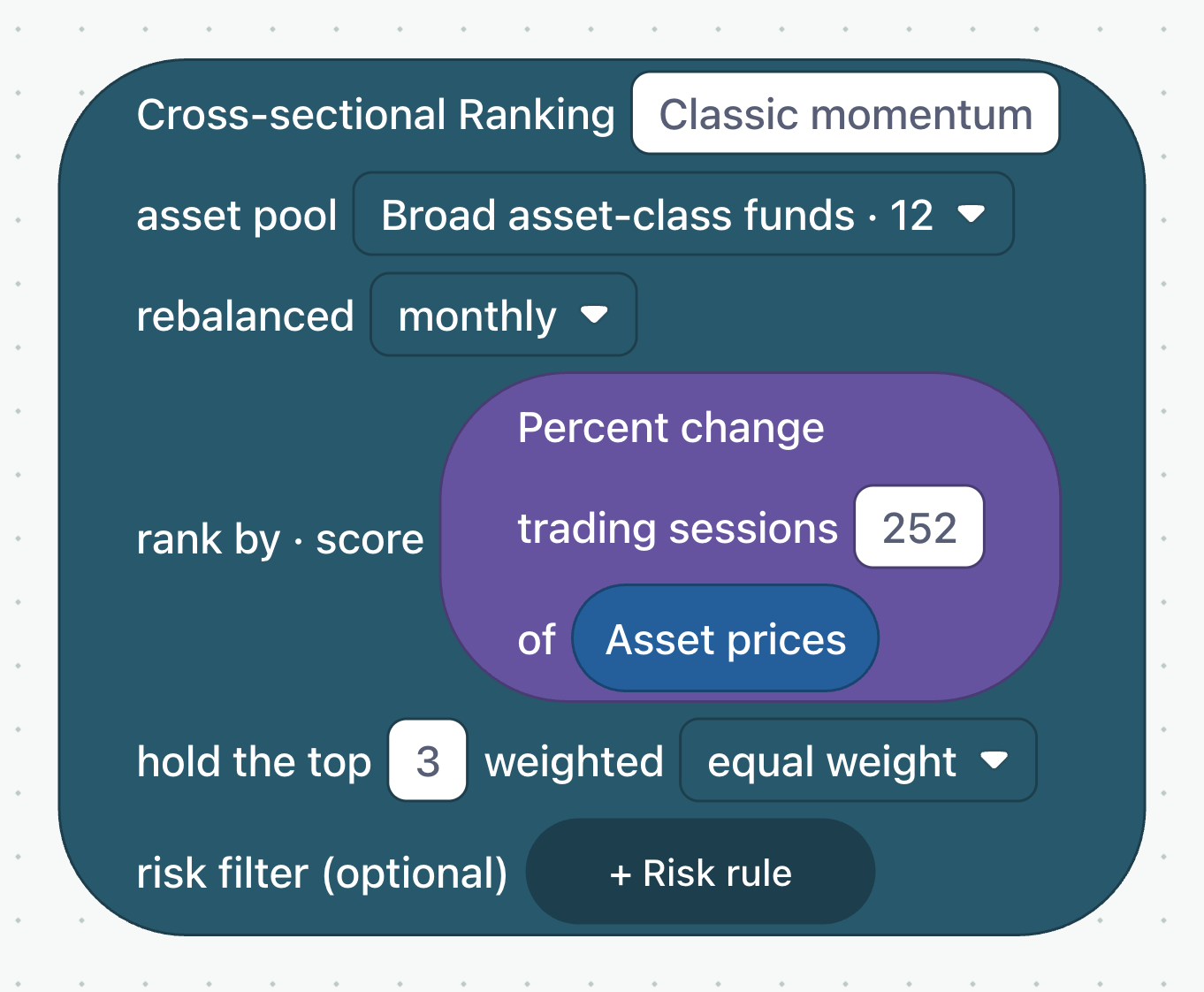
The same steps, using editable blocks.
The Classic momentum template uses a group of ETFs. The five stocks above explain the same rule: compare price changes, select the top three, and give them equal target amounts.
Company symbols: Font Awesome Free (CC BY 4.0), Simple Icons (CC0) and Google. Trademarks belong to their owners.
Start from a template
Open a template, then change its rules
In Studio a strategy is called a Mind. Templates are ready-made Minds that you can read, edit and test. Classic momentum is one of them.
Browse templates“Each month, compare how much these 12 funds rose or fell over the past year. Hold the top three, with the same amount in each.”
- Choose from
- 12 funds
- Compare
- Past-year price change
- Hold
- Top 3, equal amounts
- Review
- Monthly
Questions
What is a Mind?
Mind is Future's name for a strategy you build. Its blocks decide which assets to consider, how to compare them and how much to put in each one.
Do I need to know how to code?
No. Studio uses visual blocks. Start with a template and change its settings. Lessons and reference pages explain what each block does.
What can I try without an account?
You can run a historical backtest in the five-stock demo on this page, explore the Studio templates and read the lessons. Sign in to save your own strategies and test them in the full Studio.
Does building a strategy place a real trade?
No. Building or editing a strategy never places a real-money trade. Future tests strategies on historical data and lets you practise with virtual money. Past results do not predict future returns.
Is this the interview practice app?
No, that is a separate TradeMind product. For mental maths and quant interview assessments, visit TradeMind Prep.
Try your own investing idea
No account needed to explore.